Constitution Law Equal Access to Art and Culture Usa
half-dozen.ane Political Culture
Learning Objectives
After reading this department, you lot should be able to answer the following questions:
- What is a nation's political civilization, and why is information technology of import?
- What are the characteristics of American political culture?
- What are the values and behavior that are most ingrained in American citizens?
- What constitutes a political subculture, and why are subcultures of import?
This department defines political civilisation and identifies the core qualities that distinguish American political culture, including the land's traditions, folklore, and heroes. The values that Americans comprehend, such as individualism and egalitarianism, volition exist examined as they relate to cultural ideals.
What Is Political Civilisation?
Political culture tin be thought of equally a nation's political personality. It encompasses the deep-rooted, well-established political traits that are characteristic of a order. Political culture takes into account the attitudes, values, and beliefs that people in a society have about the political organization, including standard assumptions about the way that regime works. Equally political scientist Westward. Lance Bennett notes, the components of political civilization can be difficult to clarify. "They are rather like the lenses in a pair of spectacles: they are not the things we see when we look at the world; they are the things we see with" (Bennett, 1980). Political civilisation helps build customs and facilitate communication because people share an agreement of how and why political events, deportment, and experiences occur in their country.
Political culture includes formal rules equally well as customs and traditions, sometimes referred to equally "habits of the eye," that are passed on generationally. People agree to abide by certain formal rules, such every bit the land's constitution and codification laws. They besides alive by unstated rules: for example, the willingness in the United states to accept the outcomes of elections without resorting to violence. Political culture sets the boundaries of acceptable political behavior in a social club (Elazar, 1994).
While the civic civilization in the United States has remained relatively stable over time, shifts accept occurred as a result of transforming experiences, such equally war, economical crises, and other societal upheavals, that take reshaped attitudes and beliefs (Inglehart, 1990). Fundamental events, such equally the Civil State of war, Earth War I, Earth War Two, the Great Depression, the Vietnam War, the civil rights movement, and the terrorist attacks of 9/eleven have influenced the political worldviews of American citizens, especially immature people, whose political values and attitudes are less well established.
American Political Civilization
Political culture consists of a variety of different elements. Some aspects of culture are abstruse, such equally political beliefs and values. Other elements are visible and readily identifiable, such as rituals, traditions, symbols, folklore, and heroes. These aspects of political culture can generate feelings of national pride that grade a bail betwixt people and their country. Political culture is not monolithic. It consists of diverse subcultures based on group characteristics such every bit race, ethnicity, and social circumstances, including living in a detail identify or in a sure function of the country. We will now examine these aspects of political culture in the American context.
Beliefs
Behavior are ideas that are considered to be truthful by a society. Founders of the American commonwealth endorsed both equality, near notably in the Declaration of Independence, and liberty, most prominently in the Constitution. These political theories have become incorporated into the political culture of the United States in the fundamental behavior of egalitarianism and individualism.
Egalitarianism is the doctrine emphasizing the natural equality of humans, or at to the lowest degree the absence of a preexisting superiority of one set of humans above another. This cadre American belief is found in the preamble to the Declaration of Independence, which states that "all men are created equal" and that people are endowed with the unalienable rights to "life, liberty, and the pursuit of happiness." Americans endorse the intrinsic equal worth of all people. Survey data consistently indicate that between 80 percent and xc per centum of Americans believe that it is essential to care for all people equally, regardless of race or ethnic background (Hunter & Bowman, 1996; Pew Enquiry Middle, 2009).
The principle of individualism stresses the centrality and nobility of private people. It privileges free action and people'south ability to take the initiative in making their own lives as well as those of others more prosperous and satisfying. In keeping with the Constitution'due south preoccupation with freedom, Americans feel that children should be taught to believe that individuals can better themselves through self-reliance, hard piece of work, and perseverance (Hunter & Bowman, 1996).
The behavior of egalitarianism and individualism are in tension with one some other. For Americans today, this contradiction tends to be resolved by an expectation of equality of opportunity, the belief that each individual has the same adventure to get ahead in society. Americans tend to experience that most people who want to go ahead can brand it if they're willing to piece of work hard (Pew Research Center, 1999). Americans are more than probable to promote equal political rights, such as the Voting Rights Deed'south stipulation of equal participation for all qualified voters, than economic equality, which would redistribute income from the wealthy to the poor (Wilson, 1997).
Values
Beliefs form the foundation for values, which correspond a gild's shared convictions about what is just and practiced. Americans claim to be committed to the cadre values of individualism and egalitarianism. Yet there is sometimes a pregnant disconnect between what Americans are willing to uphold in principle and how they conduct in exercise. People may say that they support the Constitutional correct to free speech but then cramp when they are confronted with a political extremist or a racist speaking in public.
Core American political values are vested in what is often called the American creed. The creed, which was equanimous by New York Land Commissioner of Didactics Henry Sterling Chapin in 1918, refers to the belief that the United States is a government "by the people, for the people, whose simply powers are derived from the consent of the governed." The nation consists of sovereign states united as "a perfect Matrimony" based on "the principles of freedom, equality, justice, and humanity." American exceptionalism is the view that America's infrequent evolution as a nation has contributed to its special place is the globe. Information technology is the conviction that the state'southward vast frontier offered dizzying and equal opportunities for individuals to achieve their goals. Americans feel strongly that their nation is destined to serve every bit an example to other countries (Hunter & Bowman, 1996). They believe that the political and economic systems that have evolved in this country are perfectly suited in principle to permit both individualism and egalitarianism.
Consequently, the American creed also includes patriotism: the love of ane's state and respect for its symbols and principles. The events of ix/11 ignited Americans' patriotic values, resulting in many public displays of support for the land, its democratic grade of government, and authority figures in public-service jobs, such equally constabulary and firefighters. The press has scrutinized politicians for actions that are perceived to signal a lack of patriotism, and the perception that a political leader is not patriotic can generate controversy. In the 2008 presidential ballot, a minor media frenzy developed over Democratic presidential candidate Barack Obama's "patriotism trouble." The news media debated the significance of Obama's non wearing a flag lapel pin on the entrada trail and his failure to identify his hand over his heart during the playing of the national anthem.
Video Clip
Barack Obama's Patriotism
(click to see video)
A steak fry in Iowa during the 2008 Democratic presidential primary sparked a fence over candidate Barack Obama's patriotism. Obama, standing with opponents Neb Richardson and Hillary Clinton, failed to place his hand over his centre during the playing of the national anthem. In the background is Ruth Harkin, wife of Senator Tom Harkin, who hosted the consequence.
Another core American value is political tolerance, the willingness to allow groups with whom 1 disagrees to exercise their constitutionally guaranteed freedoms, such equally free speech. While many people strongly support the ideal of tolerance, they frequently are unwilling to extend political freedoms to groups they dislike. People acknowledge the constitutional right of racist groups, such as skinheads, to demonstrate in public, but will go to great lengths to forbid them from doing and then (Sullivan, Piereson, & Marcus, 1982).
Democratic political values are among the cornerstones of the American creed. Americans believe in the rule of constabulary: the thought that regime is based on a body of law, agreed on by the governed, that is applied as and justly. The Constitution is the foundation for the rule of law. The creed also encompasses the public's high caste of respect for the American system of authorities and the structure of its political institutions.
Backer economic values are embraced by the American creed. Backer economic systems emphasize the demand for a free-enterprise system that allows for open business competition, private ownership of property, and limited government intervention in business diplomacy. Underlying these capitalist values is the belief that, through difficult work and perseverance, anyone can be financially successful (McClosky & Zaller, 1987).
Figure half dozen.ane
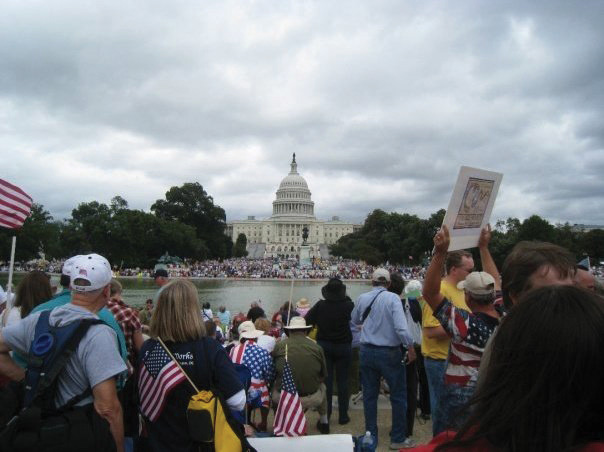
Tea Party supporters from across the country staged a "March on Washington" to demonstrate their opposition to government spending and to show their patriotism.
The primacy of individualism may undercut the status quo in politics and economics. The emphasis on the alone, powerful person implies a distrust of collective action and of ability structures such every bit large government, big business, or big labor. The public is leery of having too much power concentrated in the hands of a few large companies. The emergence of the Tea Political party, a visible grassroots bourgeois motion that gained momentum during the 2010 midterm elections, illustrates how some Americans become mobilized in opposition to the "tax and spend" policies of big regime (Pew Enquiry Center for the People and the Press, 2001). While the Tea Party shunned the mainstream media because of their view that the press had a liberal bias, they received tremendous coverage of their rallies and conventions, equally well as their candidates. Tea Party candidates relied heavily on social media, such as Facebook and Twitter, to get their anti–big government message out to the public.
Rituals, Traditions, and Symbols
Rituals, traditions, and symbols are highly visible aspects of political culture, and they are important characteristics of a nation's identity. Rituals, such as singing the national canticle at sporting events and saluting the flag before the offset of a schoolhouse solar day, are ceremonial acts that are performed by the people of a nation. Some rituals take of import symbolic and substantive purposes: Ballot Night follows a standard script that ends with the vanquished candidate congratulating the opponent on a well-fought boxing and urging support and unity behind the victor. Whether they accept supported a winning or losing candidate, voters experience meliorate about the outcome every bit a effect of this ritual (Ginsberg & Weissberg, 1978).The Land of the Union address that the president makes to Congress every January is a ritual that, in the modern era, has go an opportunity for the president to set up his policy agenda, to written report on his assistants's accomplishments, and to constitute public trust. A more recent addition to the ritual is the practise of having representatives from the president's party and the opposition give formal, televised reactions to the accost.
Figure half dozen.ii
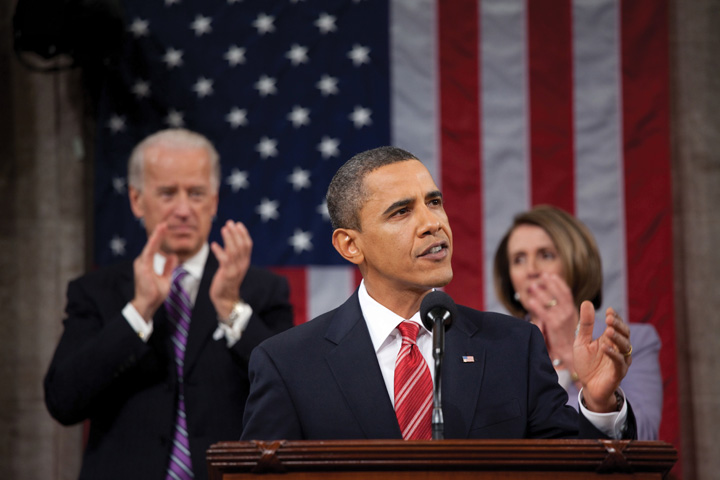
President Barack Obama gives the 2010 State of the Union address. The ritual calls for the president to be flanked by the Speaker of the Firm of Representatives (Nancy Pelosi) and the vice president (Joe Biden). Members of Congress and distinguished guests fill the House gallery.
Political traditions are customs and festivities that are passed on from generation to generation, such equally jubilant America's founding on the Fourth of July with parades, picnics, and fireworks. Symbols are objects or emblems that stand up for a nation. The flag is maybe the well-nigh meaning national symbol, especially every bit it can accept on enhanced significant when a country experiences difficult times. The bald eagle was officially adopted every bit the country's keepsake in 1787, every bit it is considered a symbol of America'due south "supreme ability and potency."
Figure vi.3
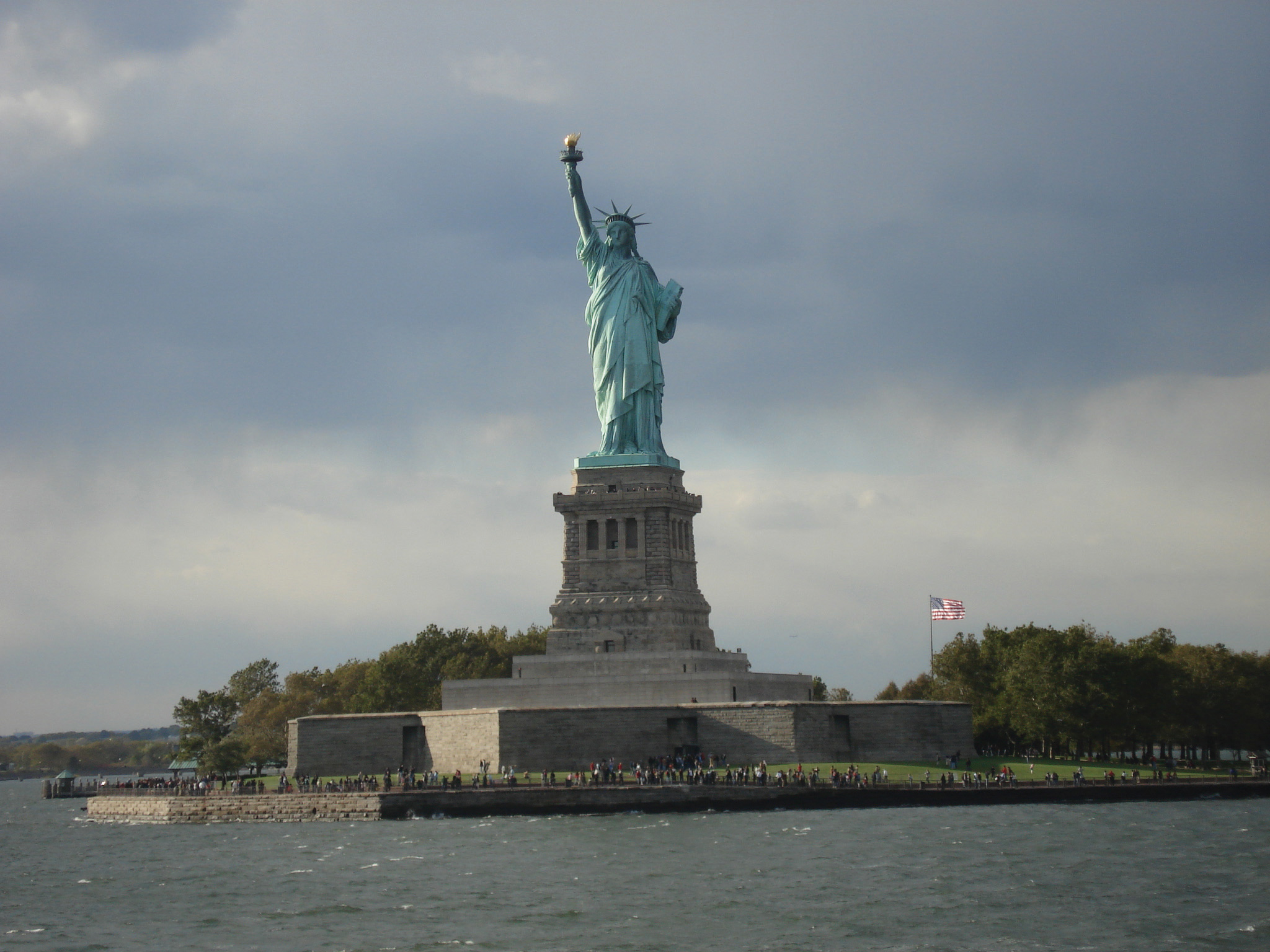
The Statue of Liberty stands in New York Harbor, an 1844 gift from France that is a symbol welcoming people from strange lands to America's shores.
Folklore
Political sociology, the legends and stories that are shared past a nation, constitutes another chemical element of culture. Individualism and egalitarianism are fundamental themes in American sociology that are used to reinforce the country's values. The "rags-to-riches" narratives of novelists—the late-nineteenth-century author Horatio Alger beingness the quintessential example—celebrate the possibilities of advancement through hard work.
Much American folklore has grown up effectually the early presidents and figures from the American Revolution. This folklore creates an paradigm of men, and occasionally women, of character and strength. Most folklore contains elements of truth, merely these stories are usually greatly exaggerated.
Effigy six.iv
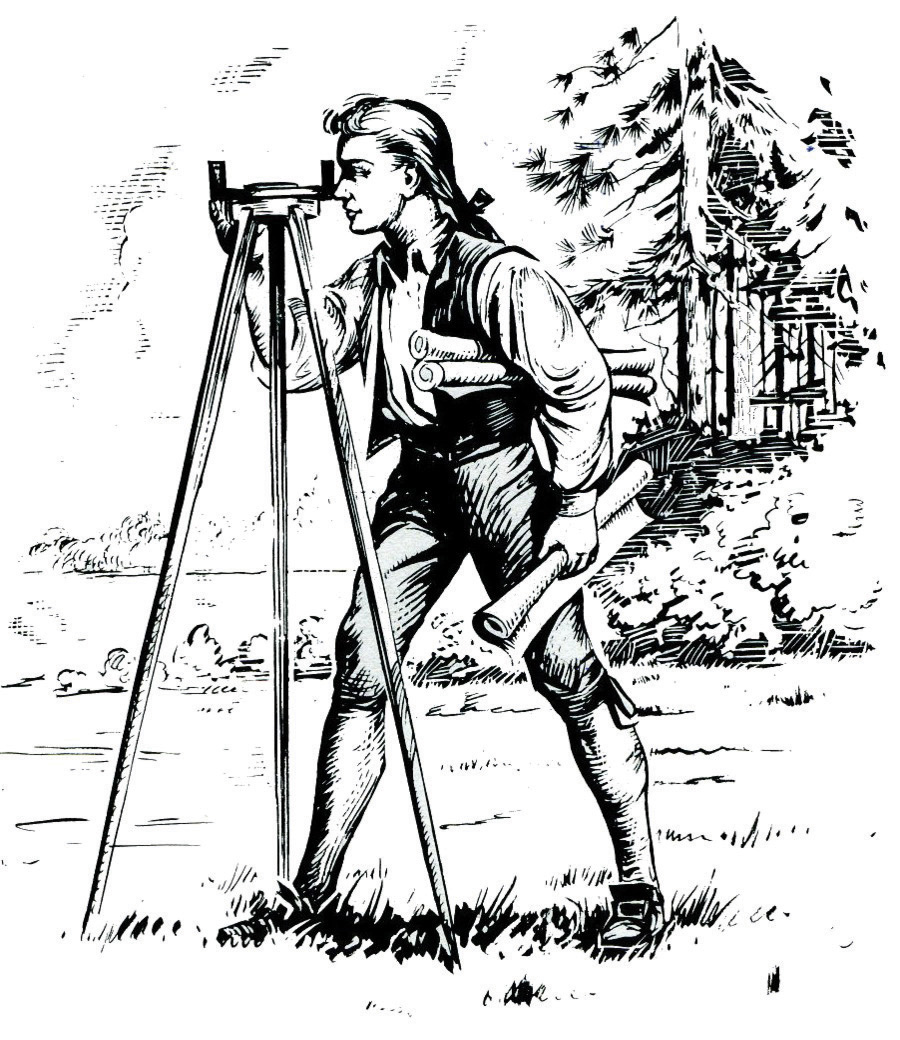
There are many folktales nigh young George Washington, including that he chopped down a scarlet tree and threw a silvery dollar beyond the Potomac River. These stories were popularized past engravings like this one by John C. Mccabe depicting Washington working as a land surveyor.
The get-go American president, George Washington, is the discipline of sociology that has been passed on to school children for more than two hundred years. Young children learn almost Washington's impeccable honesty and, thereby, the importance of telling the truth, from the legend of the cherry tree. When asked past his father if he had chopped downwards a ruddy tree with his new hatchet, Washington confessed to committing the deed by replying, "Father, I cannot tell a lie." This upshot never happened and was made by biographer Parson Mason Weems in the late 1700s (George Washington's Mount Vernon, 2011). Fable also has it that, as a male child, Washington threw a silver dollar across the Potomac River, a story meant to illustrate his tremendous physical strength. In fact, Washington was not a gifted athlete, and argent dollars did not exist when he was a youth. The origin of this folklore is an episode related by his pace-grandson, who wrote that Washington had once thrown a piece of slate beyond a very narrow portion of the Rappahannock River in Virginia (George Washington'south Mount Vernon, 2011).
Heroes
Heroes embody the human characteristics almost prized by a land. A nation'south political culture is in part divers by its heroes who, in theory, embody the best of what that state has to offer. Traditionally, heroes are people who are admired for their forcefulness of character, beneficence, courage, and leadership. People also can achieve hero condition because of other factors, such as celebrity condition, able-bodied excellence, and wealth.
Shifts in the people whom a nation identifies as heroes reflect changes in cultural values. Prior to the twentieth century, political figures were preeminent amongst American heroes. These included patriotic leaders, such as American-flag designer Betsy Ross; prominent presidents, such as Abraham Lincoln; and military leaders, such every bit Ceremonious State of war General Stonewall Jackson, a leader of the Confederate army. People learned nearly these leaders from biographies, which provided information nigh the valiant actions and patriotic attitudes that contributed to their success.
Today American heroes are more likely to come from the ranks of prominent entertainment, sports, and business organization figures than from the world of politics. Popular culture became a powerful mechanism for elevating people to hero status start effectually the 1920s. As mass media, peculiarly move pictures, radio, and television, became an important part of American life, entertainment and sports personalities who received a cracking deal of publicity became heroes to many people who were awed by their glory (Greenstein, 1969).
In the 1990s, business leaders, such as Microsoft's Beak Gates and Full general Electric's Jack Welch, were considered to exist heroes past some Americans who sought to achieve fabric success. The tenure of concern leaders every bit American heroes was short-lived, notwithstanding, equally media reports of the lavish lifestyles and widespread criminal misconduct of some corporation heads led people to become disillusioned. The incarceration of Wall Street investment advisor Bernard Madoff made international headlines every bit he was alleged to have defrauded investors of billions of dollars (Yin, 2001).
Sports figures characteristic prominently amongst American heroes, peculiarly during their prime number. Cyclist Lance Armstrong is a hero to many Americans because of his unmatched achievement of winning 7 consecutive Tour de France titles after chirapsia cancer. Withal, heroes can face opposition from those who seek to discredit them: Armstrong, for example, has been defendant of doping to win races, although he has never failed a drug exam.
Figure 6.5
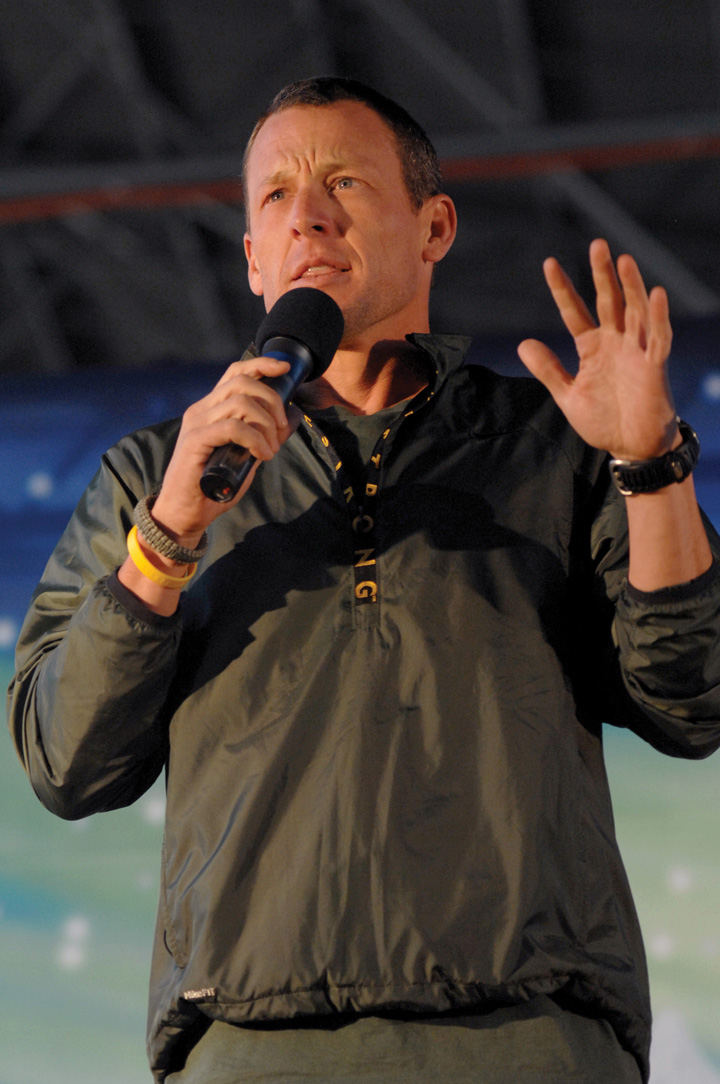
Cyclist Lance Armstrong is considered by many to exist an American hero considering of his athletic accomplishments and his fight against cancer. He likewise has been the subject of unrelenting media reports that attempt to deflate his hero status.
NBA basketball game player Michael Jordan epitomizes the modern-day American hero. Jordan'south hero condition is vested in his power to bridge the world of sports and business organization with unmatched success. The media promoted Jordan's hero image intensively, and he was marketed commercially past Nike, who produced his "Air Jordans" shoes (Walters, 1997). His unauthorized 1999 picture show biography is titled Michael Jordan: An American Hero, and information technology focuses on how Jordan triumphed over obstacles, such every bit racial prejudice and personal insecurities, to become a role model on and off the basketball game court. Young filmgoers watched Michael Jordan help Bugs Bunny defeat evil aliens in Space Jam. In the film Like Mike, pint-sized rapper Lil' Bow Wow plays an orphan who finds a pair of Michael Hashemite kingdom of jordan's basketball shoes and is magically transformed into an NBA star. Lil' Bow Wow's story has a happy catastrophe because he works difficult and plays past the rules.
The ix/eleven terrorist attacks prompted Americans to make heroes of ordinary people who performed in extraordinary means in the face of adversity. Firefighters and police officers who gave their lives, recovered victims, and protected people from further threats were honored in numerous ceremonies. Also treated as heroes were the passengers of Flight 93 who attempted to overtake the terrorists who had hijacked their plane, which was believed to be headed for a target in Washington, DC. The plane crashed in a Pennsylvania field.
Subcultures
Political subcultures are distinct groups, associated with particular beliefs, values, and behavior patterns, that be within the overall framework of the larger culture. They can develop around groups with distinct interests, such as those based on age, sexual practice, race, ethnicity, social class, religion, and sexual preference. Subcultures as well tin can be geographically based. Political scientist Daniel Elazar identified regional political subcultures, rooted in American immigrant settlement patterns, that influenced the style that regime was constituted and practiced in different locations across the nation. The moral political subculture, which is present in New England and the Midwest, promotes the common adept over individual values. The individual political subculture, which is axiomatic in the middle Atlantic states and the West, is more than concerned with private enterprise than societal interests. The traditional political subculture, which is establish in the S, reflects a hierarchical societal structure in which social and familial ties are cardinal to holding political ability (Elazar, 1972). Political subcultures tin can as well grade around social and artistic groups and their associated lifestyles, such as the heavy metal and hip-hop music subcultures.
Media Frames
The Hip-Hop Subculture
A cohort of black Americans has been labeled the hip-hop generation by scholars and social observers. The hip-hop generation is a subculture of generation X (people born between 1965 and 1984) that identifies strongly with hip-hop music as a unifying forcefulness. Its heroes come from the ranks of prominent music artists, including Grandmaster Flash, Chuck D, Run DMC, Ice Cube, Sister Souljah, Nikki D, and Queen Latifah. While a small-scale number of people who identify with this subculture advocate extreme politics, including violence against political leaders, the vast majority are peaceful, law-abiding citizens (Kitwana, 2002).
The hip-hop subculture emerged in the early 1970s in New York City. Hip-hop music began with party-oriented themes, but past 1982 it was focusing heavily on political issues. Dissimilar the preceding civil rights generation—a black subculture of babe boomers (people born immediately after World War II) that concentrated on achieving equal rights—the hip-hop subculture does not have an overarching political agenda. The messages passed on to the subculture by the music are highly varied and frequently contradictory. Some lyrics express frustration almost the poverty, lack of educational and employment opportunities, and loftier criminal offense rates that plague segments of the black community. Other songs provide public service messages, such every bit those included on the Stop the Violence album featuring Public Enemy and MC Lyte, and Common salt-N-Pepa's "Let's Talk virtually AIDS." Music associated with the gangsta rap genre, which was the production of gang culture and street wars in Due south Central Los Angeles, promotes violence, especially against women and authority figures, such as the police. It is from these lyrics that the mass media derive their nigh prominent frames when they cover the hip-hop subculture (Marable, 2002).
Media coverage of the hip-hop subculture focuses heavily on negative events and issues, while ignoring the socially constructive messages of many musicians. The subculture receives most of its media attention in response to the murder of prominent artists, such as Tupac Shakur and Notorious B.I.G., or the abort of musicians for violating the law, commonly for a weapons- or drug-related charge. A prominent news frame is how violence in the music's lyrics translates into real-life violence. Equally hip-hop music became more pop with suburban white youth in the 1990s, the news media stepped up its warnings about the dangers of this subculture.
Media reports of the hip-hop subculture also coincide with the release of successful albums. Since 1998, hip-hop and rap have been the top-selling record formats. The dominant news frame is that the hip-hop subculture promotes selfish materialist values. This is illustrated by news reports about the cars, homes, jewelry, and other commodities purchased past successful musicians and their promoters (Lewis, 2003).

Media coverage of hip-hop tends to downplay the positive aspects of the subculture.
Although the definition of political civilization emphasizes unifying, commonage understandings, in reality, cultures are multidimensional and often in disharmonize. When subcultural groups compete for societal resource, such every bit access to government funding for programs that will do good them, cultural cleavages and clashes can issue. Every bit we will see in the section on multiculturalism, conflict betwixt competing subcultures is an ever-present fact of American life.
Multiculturalism
One of the hallmarks of American civilization is its racial and ethnic diversity. In the early twentieth century, the playwright Israel Zangwill coined the phrase "melting pot" to describe how immigrants from many dissimilar backgrounds came together in the U.s.a.. The melting pot metaphor assumed that over time the distinct habits, community, and traditions associated with particular groups would disappear equally people assimilated into the larger civilization. A uniquely American culture would emerge that accommodated some elements of diverse immigrant cultures in a new context (Fuchs, 1990). For example, American holiday celebrations comprise traditions from other nations. Many common American words originate from other languages. Yet, the melting pot concept fails to recognize that immigrant groups do not entirely abandon their distinct identities. Racial and ethnic groups maintain many of their basic characteristics, simply at the same fourth dimension, their cultural orientations change through matrimony and interactions with others in society.
Over the past decade, there has been a tendency toward greater acceptance of America's cultural multifariousness. Multiculturalism celebrates the unique cultural heritage of racial and ethnic groups, some of whom seek to preserve their native languages and lifestyles. The United States is home to many people who were born in strange countries and yet maintain the cultural practices of their homelands.
Multiculturalism has been embraced past many Americans, and it has been promoted formally by institutions. Elementary and secondary schools take adopted curricula to foster understanding of cultural diversity past exposing students to the customs and traditions of racial and ethnic groups. As a outcome, immature people today are more tolerant of diversity in society than whatsoever prior generation has been. Government agencies advocate tolerance for diversity by sponsoring Hispanic and Asian American/Pacific Islander heritage weeks. The US Postal service has introduced stamps depicting prominent Americans from diverse backgrounds.
Figure half-dozen.half-dozen

Americans celebrate their multicultural heritage past maintaining traditions associated with their homelands.
Despite these trends, America'southward multiculturalism has been a source of societal tension. Back up for the melting pot assumptions about racial and ethnic absorption still exists (Hunter & Bowman, 1996). Some Americans believe that besides much endeavor and expense is directed at maintaining dissever racial and ethnic practices, such equally bilingual education. Disharmonize can ascend when people feel that society has gone too far in all-around multiculturalism in areas such every bit employment programs that encourage hiring people from varied racial and indigenous backgrounds (Pew Enquiry Heart for the People and the Printing, 1999).
Enduring Images
The 9/xi Firefighters' Statue
On 9/eleven Thomas Eastward. Franklin, a lensman for Bergen County, New Bailiwick of jersey's Record, photographed three firefighters, Billy Eisengrein, George Johnson, and Dan McWilliams, raising a flag amid the smoldering rubble of the World Merchandise Center. Labeled by the press "the photograph seen 'round the earth," his image came to symbolize the strength, resilience, and heroism of Americans in the face of a direct attack on their homeland.
Developer Bruce Ratner deputed a nineteen-human foot-tall, $180,000 statuary statue based on the photograph to stand in front of the New York City Fire Department (FDNY) headquarters in Brooklyn. When the statue prototype was unveiled, information technology revealed that the faces of 2 of the iii white firefighters who had originally raised the flag had been replaced with those of black and Hispanic firefighters. Ratner and the artist who designed the statue claimed that the modification of the original prototype represented an effort to promote America's multicultural heritage and tolerance for multifariousness. The change had been authorized past the FDNY leadership (Dreher, 2002).
The modification of the famous photo raised the event of whether it is valid to alter historical fact in order to promote a cultural value. A heated controversy bankrupt out over the statue. Supporters of the change believed that the statue was designed to accolade all firefighters, and that representing their diverse racial and ethnic backgrounds was warranted. Blackness and Hispanic firefighters were amongst the 343 who had lost their lives at the Globe Merchandise Center. Kevin James of the Vulcan Society, which represents black firefighters, defended the determination by stating, "The symbolism is far more important than representing the actual people. I recall the creative expression of multifariousness would supersede any concern over factual definiteness."[1]
Opponents claimed that since the statue was not meant to be a tribute to firefighters, but rather a depiction of an actual event, the representation needed to be historically accurate. They drew a parallel to the famous 1945 Associated Printing photo of six Marines raising the flag on Iwo Jima during World War Ii and the historically precise memorial that was erected in Arlington, Virginia. Opponents likewise felt that it was wrong to politicize the statue by making it part of a dialogue on race. The proposed statue promoted an prototype of diversity within the FDNY that did not mirror reality. Of the FDNY'due south 11,495 firefighters, 2.7 percent are black and 3.ii per centum are Latino, percentages well beneath the percentage these groups represent in the overall population.
Some people suggested a compromise—two statues. They proposed that the statue based on the Franklin photo should reflect historical reality; a second statue, celebrating multiculturalism, should be erected in front of another FDNY station and include depictions of rescue workers of diverse backgrounds at the World Trade Center site. Plans for any type of statue were abased as a result of the controversy.
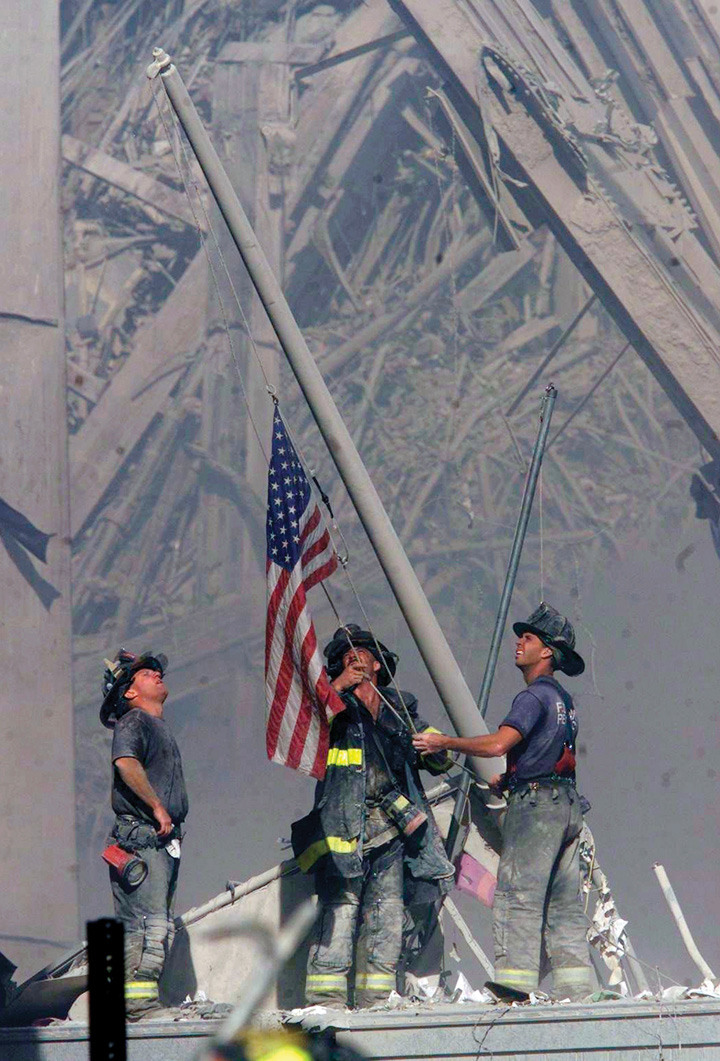
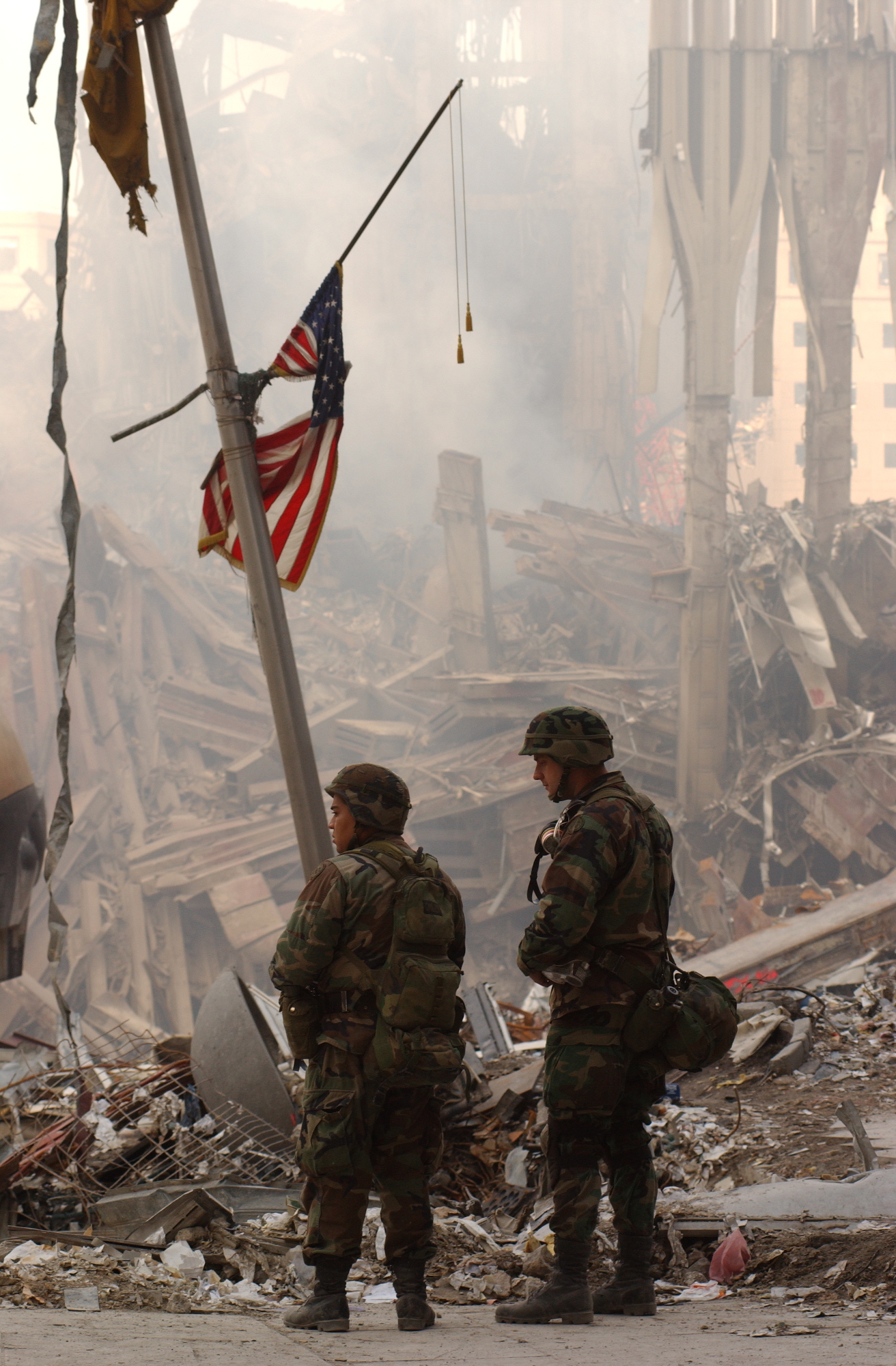
The iconic photograph of 9/11 firefighters raising a flag most the rubble of the Globe Trade Heart plaza is immortalized in a US postage stamp. Thomas Franklin, the veteran reporter who took the photo, said that the image reminded him of the famous Associated Printing image of Marines raising the American flag on Iwo Jima during World War Two.
Fundamental Takeaways
Political culture is defined by the ideologies, values, beliefs, norms, customs, traditions, and heroes characteristic of a nation. People living in a item political culture share views about the nature and operation of government. Political culture changes over fourth dimension in response to dramatic events, such as war, economic collapse, or radical technological developments. The core American values of democracy and capitalism are vested in the American creed. American exceptionalism is the idea that the country has a special place in the world because of the circumstances surrounding its founding and the settling of a vast frontier.
Rituals, traditions, and symbols bail people to their culture and tin can stimulate national pride. Sociology consists of stories about a nation's leaders and heroes; oftentimes embellished, these stories highlight the graphic symbol traits that are desirable in a nation's citizens. Heroes are important for defining a nation'due south political culture.
America has numerous subcultures based on geographic region; demographic, personal, and social characteristics; religious affiliation, and creative inclinations. America'due south unique multicultural heritage is vested in the various racial and ethnic groups who accept settled in the state, but conflicts tin arise when subgroups compete for societal resources.
Exercises
- What exercise y'all retrieve the American flag represents? Would it bother yous to see someone burn an American flag? Why or why not?
- What distinction does the text brand between beliefs and values? Are there things that you believe in principle should be done that you might be uncomfortable with in practise? What are they?
- Do you agree that America is uniquely suited to foster freedom and equality? Why or why not?
- What characteristics make yous call back of someone as particularly American? Does race or cultural background play a role in whether yous retrieve of a person equally American?
References
Bennett, W. Fifty., Public Opinion in American Politics (New York: Harcourt Brace Jovanovich, 1980), 368.
Dreher, R., "The Bravest Speak," National Review Online, Jan 16, 2002.
Elazar, D. J., American Federalism: A View From united states, 2nd ed. (New York: Thomas Y. Crowell, 1972).
Elazar, D. J., The American Mosaic (Boulder, CO: Westview Printing, 1994).
Fuchs, 50. H., The American Kaleidoscope. (Middletown, CT: Wesleyan University Press, 1990).
George Washington's Mount Vernon, "Did George Washington actually throw a silvery dollar across the Potomac River?," accessed February 3, 2011, http://world wide web.mountvernon.org/noesis/alphabetize.cfm/fuseaction/view/KnowledgeID/xx.
George Washington's Mountain Vernon, "Is it truthful that George Washington chopped down a crimson tree when he was a boy?," accessed Feb three, 2011, http://www.mountvernon.org/knowledge/index.cfm/fuseaction/view/KnowledgeID/21.
Ginsberg, B. and Herbert Weissberg, "Elections and the Mobilization of Pop Support," American Journal of Political Science 22, no.1 (1978): 31–55.
Greenstein, F. I., Children and Politics (New Haven, CT: Yale University Printing, 1969).
Hunter, J. D. and Carl Bowman, The Country of Disunion (Charlottesville, VA: In Media Res Educational Foundation, 1996).
Inglehart, R., Culture Shift in Advanced Industrial Society (Princeton, NJ: Princeton Academy Press, 1990).
Kitwana, B., The Hip-Hop Generation (New York: Bones Civitas Books, 2002).
Lewis, A., "Vilification of Black Youth Culture past the Media" (principal's thesis, Georgetown University, 2003).
Marable, M., "The Politics of Hip-Hop," The Urban Think Tank, 2 (2002). http://www.hartford-hwp.com/athenaeum/45a/594.html.
McClosky, H. and John Zaller, The American Ethos (Cambridge, MA: Harvard University Press, 1987).
Pew Research Middle for the People and the Printing, Retro-Politics: The Political Typology (Washington, DC: Pew Research Heart, November 11, 1999).
Pew Research Center for the People and the Press, Values Survey (Washington, DC: Pew Research Middle, March 2009).
Pew Enquiry Eye for the People and the Printing, Views of Business and Regulation Remain Unchanged (Washington, DC: Pew Enquiry Center, February 21, 2001).
Sullivan, J. L., James Piereson, and George Due east. Marcus, Political Tolerance and American Democracy (Chicago: University of Chicago Press, 1982).
Walters, P., "Michael Jordan: The New American Hero" (Charlottesville VA: The Crossroads Project, 1997).
Wilson, R. West., "American Political Civilization in Comparative Perspective," Political Psychology, xviii, no. ii (1997): 483–502.
Yin, S., "Shifting Careers," American Demographics, 23, no. 12 (December 2001): 39–forty.
Source: https://open.lib.umn.edu/americangovernment/chapter/6-1-political-culture/
0 Response to "Constitution Law Equal Access to Art and Culture Usa"
Enregistrer un commentaire