Transporting Art Goods to Be Sold in the Us
Due east arly one morning last summer, I stood inside a museum in Antwerp and watched as a painting was hung on the wall. When I walked in, the gallery was empty. To one side, there was a crate virtually a metre foursquare. Royal blue, it was unmarked apart from a code number and a yellowish stencilled sign reading "Lato da Aprire / Open this Side". Although its domicile is nominally Florence, the painting inside was a seasoned traveller: it had arrived the night before from Sicily, by road and nether armed baby-sit. The box looked entirely unremarkable. That was the indicate, I was told.
Abruptly, in that location was a commotion: the curator of the exhibition, a visiting curator, a translator, an expert in Renaissance art, plus a clutch of hangers-on, burst through the doors. 2 art handlers wearing gloves and sober expressions strode over to a table; on it, pliers, record measures, and an electric screwdriver had been placed with a precision that would not have been out of place in an operating theatre.
While the grouping noisily exchanged paperwork and air kisses, the visiting curator – who had accompanied the painting on its journey – gave the handlers sotto voce instructions. The crate was laid flat on the floor, its hat unscrewed and the cream packing lifted out. The screws that would attach the painting to the wall were held up for inspection; she gave a curt nod of assent. The but audio was the squeak of one handler's trainers on the flooring.
As the final layer of foam came off, in that location was a flash of gold reflected on the gallery ceiling. Craning my neck, I glimpsed the border of Caravaggio'due south Boy Bitten By a Lizard, one of the artist'southward most sensational early on masterworks – a young face contorted in shock and pain, body twisted, eyes dark and cheeks flushed. Gently, the handlers placed the painting, one of two authenticated versions, on the table. There was a scattering of applause. It was though a glory had materialised in our midst.
Fifty-fifty if y'all are an obsessive gallery-goer, it'south possible y'all haven't put much idea into how the works on the wall came to be in that location. The art world prefers information technology this way: what happens backside the signs reading "No Entry: Installation in Progress" remains a ferociously guarded surreptitious. The but hint that this Song dynasty bronze has arrived from that private collection in Taiwan, for example, is a discreet credit on the wall. It may be that, absorbed in our contiguous encounter with the artwork – what Walter Benjamin described as its "aura" – many of the states prefer non to gaze too deeply into that mystery.
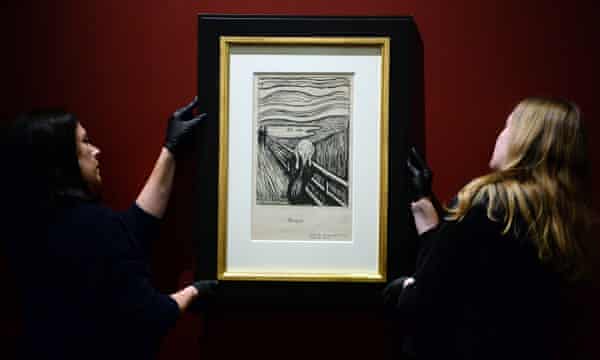
Yet the mechanisms required to go that bronze from Taipei to St Ives – loan agreements, insurance, packing, couriering, shipping, handling, installation – are delicate, expensive and complex. Behind every exhibition is an intricate logistical spider web that reaches across the globe.
Institutions are nether huge pressure level to share collections, both in the UK and internationally. Missed Frida Kahlo at the V&A? Information technology has recently opened at Brooklyn Museum, just as the Metropolitan Museum's 2017 exhibition of early Diane Arbus has come up to London. The British Museum'south A History of the World in 100 Objects is shortly to arrive in Hong Kong, by way of Abu Dhabi, Taiwan, Japan, Australia and China. It has been on the road since 2016. Many museums at present rely on blockbuster exhibitions to drive visitor numbers; often, the only style of paying for these is to partner with another institution and send the show on tour.
The demands of creating big shows populated with star loans, and the logistics required to brand them come together, are intense. "Information technology has get a sort of arms race," said one curator I spoke to, with a trace of a sigh.
A hyperactive fine art market creates a momentum all its own. Co-ordinate to the well-nigh recent analysis, global fine art sales total most $68bn (£52bn) annually, a ten% increment since 2008, with some 40m transactions made last year lone. Vast quantities of art are continually being shifted from auction houses to purchasers to dealers and back again, specially in the fast-expanding Asian markets. Two decades ago, there were effectually 55 major commercial art fairs; at present, in that location are more than 260.
The stop effect is that more art than ever, worth more coin than ever, is travelling more than than ever. Fine-art aircraft is expensive, specialised and technically challenging work. Old masters are fragile, only some contemporary sculptures are so friable – or so poorly fabricated – that moving them anywhere is a major risk. And there is the added pressure of treatment artefacts that are almost immeasurably culturally important.
There is possibly some other paradox here, too: drastic for a glimpse of genuine "aura" in an era of digital reproduction, we crave that once-in-a-lifetime opportunity to come across those real Cézannes sharing a existent wall, and stand up in their presence, as the artist stood. But although the real value of a piece of work of art lies in its beingness seen, simply putting it on display – let alone making it travel – is guaranteed to put it at risk, and probably shorten its life. "At the finish of the 24-hour interval, you lot accept to make your peace with that," one conservator said. "You have to call back what art is for."
50 ate final July at the National Gallery in London, the summer exhibition was winding down. In a matter of days, the installation team would begin preparing the space for the autumn evidence, devoted to the 15th-century Venetian painters Andrea Mantegna and Giovanni Bellini. The walls were most to exist repainted, and custom-built cabinets moved in. In a ground-flooring studio, ii carpenters were carving and gilding new frames. A few feet away, on the other side of a locked door, visitors blithely unaware of all this industry were sipping coffee in the espresso bar.
In an office in the bowels of the building, the lead curator, Caroline Campbell, was picayune with a battered, grubby foam scale model of the gallery'southward Sainsbury Wing. The model's walls were busy with tiny colour print-outs of paintings, affixed with Blu-Tack.
Campbell's plan was to bear witness about 100 paintings, drawings and sculptures. The majority would have to travel from museums, galleries and private collections across the world; a third of these would never accept been seen in the United kingdom earlier. Then, in one case the show closed in late January, the pictures would travel, en masse, to the Gemäldegalerie in Berlin. It was a herculean effort, and the first time the museums had collaborated on a project of this scale.
"A lot of moving parts," Campbell said, frowning at a doll's-firm Mantegna, before moving information technology a few millimetres along a tiny wall.
Past this point, she had already spent some 6 years planning the exhibition, after get-go pitching it to her bosses in 2012. And so came a hectic round of wooing – bringing the Berliners fully on board, approaching potential lenders in Frankfurt, Vienna, Los Angeles, Bristol, Brescia, Copenhagen, Sao Paolo and many other places as well. Where possible, Campbell made visits to request loans in person: the first of many homo links in a concatenation that, she hoped, would eventually bring the works to London.
"They're treasures, we have to remember that," she said. "They're giving us their crown jewels."
A registrar at another institution highlighted the pressures of mounting a major loan exhibition. "There'southward a tonne of quid pro quo, a lot of brinkmanship," he said. "Loans can plough into bargaining chips: 'Sure, we'll lend you our Gauguin, merely did you lot get our letter about your Titian … ?'"
Negotiations tin can drag on for years. Although the language ("loan", "courtesy of") sounds amiable plenty, rivalries can be bitter, resembling the trading of star players between Premiership football game clubs. A major international museum such as MoMA in New York has an enormous amount of leverage, because of its reputation, endowment and drove, but a small gallery with 1 star work can dial above its weight if it approaches the process cannily.
Even one time loans are agreed in principle, the real haggling is still to come. How will the art travel, and when? Who pays for insurance and aircraft? (Usually the borrower.) What kind of "display furniture" needs to be built? What kind of security systems are in identify – attack-proof vitrines, alarms, guards? How well-nigh temperature and humidity?
Frequently, explained the registrar, the battles are internal, betwixt an establishment's own curators and conservators. "You just know that, if it'due south a 14th-century Florentine panel painting that's too delicate to go anywhere, some curator at another museum is going to want it." He laughed. "The moment you lot put something on brandish, it'due south at risk. But so if you listened to me, nosotros'd never put annihilation on display at all."
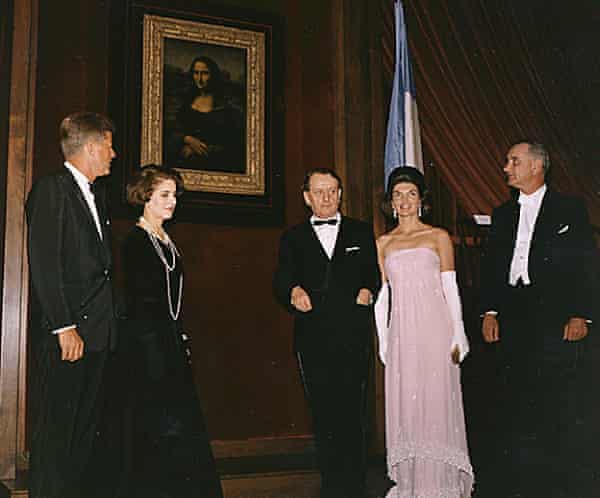
Steadily, a loan list for the prospective exhibition comes together: definites, likelies, we-can-but-dreams. Consign licences need to be procured. Some works are regarded as so of import that loans need to be sanctioned at government level – when the Mona Lisa travelled to the US in 1963, it was brokered by none less than Jackie Kennedy. The politics and paperwork can be so circuitous that lists sometimes aren't finalised until a matter of weeks before a show opens.
Insurance is a specially thorny topic. In the Great britain, many loans are covered by an indemnity scheme underwritten past the government – the Government Indemnity Scheme or GIS – which ways that if, say, a visitor puts a pes through a Monet on loan from a France, the UK'south Department for Digital, Culture, Media and Sport (DCMS) picks up the pecker. The thought is that British institutions don't take to stump up for commercial insurance: the premium on a work by a major-league artist on three-month loan might be £80,000.
That organisation sounds sensible, just that hyperactive art market has played havoc with it. The average price for fine fine art at sale has almost doubled since 2000, meaning that the costs of indemnifying works on loan has soared. The latest government figures reveal that DCMS has "indemnities in force" for artworks valued at some £xviii.7bn. Terminal year, the nation was potentially liable for £8.25bn for loans to Tate alone. (In 2017-18, Tate deemed for fifty-fifty more, £11.7bn; the museum pointed out that "our programme includes some of the major figures in mod and contemporary art".) Fortunately for the British taxpayer, claims on the GIS aren't often made, partly because information technology is rare for works to be damaged then catastrophically every bit to exist unsalvageable: in the past 34 years, the scheme has paid out an average of but £46,000 a year.
In spite of these assurances, 1 conservator I interviewed still fretted well-nigh the works entrusted to her safekeeping: how would they cope with the journey, would they be cared for when they arrived, would that niggling ailment flare up, would they get everything they needed while they were away. Time and again when speaking to people near art on the motion, I was put in mind of people worrying fondly about venturesome elderly relatives almost to embark on a major trip abroad.
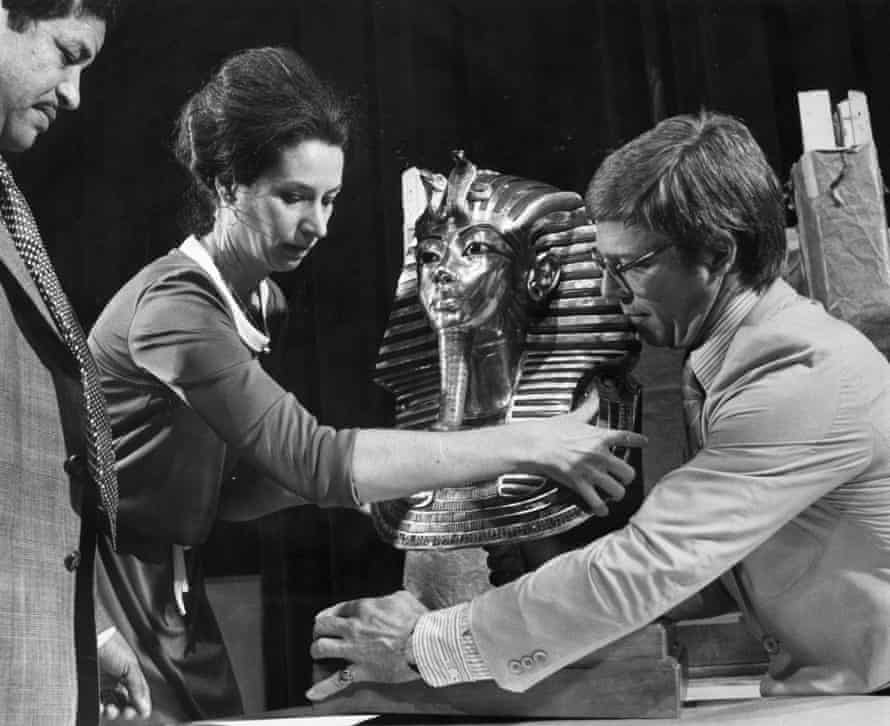
T he modern era for drifting art blockbusters began in the early 1960s, aided by the inflow of large jet airliners capable of conveying freight long-haul direct and fast. It is oftentimes credited to the Cairo museum'southward spectacular Treasures of Tutankhamun exhibition – nicknamed the "grandaddy of all blockbusters" – which first arrived in the U.s.a. in 1961 and spent much of the side by side xx years on the motion, making a stately progress across Japan, France, the UK, the Soviet Marriage and Frg, and alluring unprecedented numbers of visitors (Steve Martin's sardonic novelty striking "Rex Tut" sold more than a million copies). Normally, the artefacts travelled in bespoke, fortified wooden cases divided between three planes, indemnified for the and then-unprecedented amount of £9m (perhaps £135m in today'due south money). When they came to London in 1972, an RAF plane was laid on to carry Tutankamun'south famous mask.
Curators at the Louvre were aghast afterward they heard that Jackie Kennedy had charmed the French culture minister André Malraux into agreeing to loan the Mona Lisa to the Usa in 1963 (many threatened to resign). Even the director of the National Gallery of Art in Washington DC was unwilling to take information technology, humble most the risks. In the end, the United states of america Coast Guard accompanied the liner carrying the painting as it entered New York harbour, and when the crate arrived in Washington, it was driven through town in a secure convoy with all traffic stopped. All the same, a faulty fire sprinkler went off while the work was in storage at the Metropolitan museum in New York, and it got damp. (Fortunately, so as now, the paint surface was protected by glass.)
The Mona Lisa's bout was regarded as such a success that information technology launched what one observer has called "a column of risky, armoured loans of never-before-travelled, shrine-similar masterpieces". In 1964, Michaelangelo'southward marble Pietà (1499) travelled from St Peter's in Rome to the 1964-65 World'southward Fair in Flushing Meadows, New York, where it was displayed backside a thick glass wall, viewed past visitors from a moving walkway.
The mode for blockbuster touring shows – what the New York Times architecture critic called in 1978 "the growth of the museum equally circus, or spectacle, or cash register" – has increased exponentially in the ensuing decades, driven by funding cuts and museums' frantic need to monetise their collections. Fifty years afterward, we are in a different league entirely. In 2018, the British Museum opened 13 international touring exhibitions, while the V&A had 11 shows travelling internationally and another 7 on the road in the United kingdom of great britain and northern ireland.
The cost might not simply be to the art being shunted incessantly effectually the world, but to u.s., the people who love and want to run into it. If a spectacular prove packed with frail loans is and so thronged with visitors that we never get most the pictures, despite paying £30 or more for a ticket, then nosotros might wonder what the point is. Every so frequently, someone calls fourth dimension on the era of blockbusters, only – Rembrandts at the Rijksmuseum, Da Vinci at the Louvre, Bauhaus 100 – they show no sign of disappearing. Granted fresh life by Instagram and performative encounters with live feel, they appear to be what many of us want from art.
South omewhere forth a puzzle of corridors inside the V&A in South Kensington is a silent passageway lined by fireproof security doors and guarded by fingerprint-sensitive locks. These are the "transit" stores, where objects go when they have been called up from deep storage in lodge to be packed up and sent out.
Near the loading bay when I visited one afternoon was a jumble of empty wooden cases painted an austere shade of grey. Every museum has its own color, to brand identification easier: the Metropolitan in New York practice theirs deep blue.
Behind the fireproof doors lay the treasures. A 17th-century Dutch landscape was resting on cream cushions, blue Wedgwood china piled on a steel rack. It looked as if someone fabulously wealthy was in the midst of a car boot sale. Scribbling notes – no photographs immune – I almost bumped into a classic Hans Wegner chair, before a hand touched my arm and guided me abroad. "When objects motion, that'due south when they're most at risk," Nickos Gogolos, the owner of the mitt, said.
Gogolos is head registrar at the V&A, managing a team of eight whose job is to keep tabs on the collection, both on and off the premises. Given that the museum now lends out most 3,000 objects a yr to around 350 venues across the world (a sizeable number are long-term loans to British stately homes and local galleries), an increasing percentage of Gogolos's job consists of treatment loans.
"The task has got massively busier," Gogolos said when we sabbatum down in his office; I couldn't help noticing that his noticeboard was covered in mindfulness quotes.
Shipping museum-course art is a specialist business concern: only a scattering of top-flying firms, among them the London-based Momart and Constantine, are trusted past major institutions. All the same, most museums also insist that art on loan travels at all times with a courier, ideally a conservator. This is known as "nail to nail": 1 person stays with one work from the moment it is taken downwards in Room 38A of the V&A to the moment it goes on to the wall in a museum in Shanghai 5,700 miles away. Unless physically impossible, they demand to stick with the artefact – or at least the crate information technology is travelling in – every pace of the fashion.
The journey often begins in the grey pre-dawn hours, when couriers join the crate at the museum equally information technology is loaded on to a secure van for onward transport. Small items such as books or manuscripts can be taken on equally hand luggage, although this will require documentation and probably lengthy questioning at security. Also, the object volition need its ain beginning-class seat. "Yous don't want to go leaving it in the overhead compartment," the registrar explained. "That's a whole other thing."
Some sculptures are and so huge, or then heavy, that the only way is by aircraft container (although getting them in to Art Basel Miami, which happens in early December, the tail end of hurricane flavor, makes that risky in different means). More often, though, artworks travel every bit air freight, which means arriving at the drome at to the lowest degree four or five hours in advance and monitoring the crate beingness lifted into the belly of the aircraft. If possible, information technology will be booked on a regular passenger flight, which means the courier can travel with information technology. If the crate is besides large, then infinite on a freight plane with higher clearance must be booked.
Northward one of this comes inexpensive, needless to say: getting a unmarried object to the Britain from Commonwealth of australia and dorsum might toll £sixty,000, while trucking works from France might toll £25,000. Shippers request "must-ride" status for their artworks to avoid the take a chance of them hanging effectually in airports, only it can still exist trumped by higher-priority cargo. The registrar told me: "Horses tend to win, because they have to travel same-day, and no 1 worries near the toll. I had a instance recently where they'd lost the forms at the airport and were going to bump my shipment. I well-nigh lost out to some fresh fish."
The registrar recalled one courier who watched his crate go along, signed the paperwork – and then missed the flight. "He chosen me from the deviation lounge, saying that the work he was meant to be couriering had just taken off. I was like: 'Yous had 1 fucking job … '" (In 2010, a courier lost a portrait past the 19th-century French artist Corot worth some £850,000 while drunk in a New York hotel bar. It turned upward a few weeks later.)
Assuming they have both made it to the destination, the courier watches the crate leave the plane, before joining it in another climate-controlled truck for transit to the host museum. If an overnight stop is required, either a secure, climate-controlled fine art warehouse must be booked en route – at that place is a network of these across Europe, owned by different aircraft firms – or, more likely, someone stays in the truck at all times, to the extent of sleeping in it.
Even a medium-sized exhibition may contain 80 artefacts, each of which needs to achieve its destination at exactly the right moment (installations for a major show are so tight that courier arrivals are booked on an hour-by-hour schedule). Multiply that past the number of touring exhibitions – the V&A currently has 12 on the road – and you tin can run into why a registrar might be in need of a mindfulness poster or 2.
"If yous've got a lorry with 3 Matisses stuck in snow in Latvia, that'southward stressful," the registrar said. "Once I had a loan that was travelling through the US and the lorry broke down in the middle of Texas; the spare part had to come from somewhere four hours away. They saturday by the side of the road. I merely had to pray no one knew what the cargo was."
Among all this, the artwork itself should barely notice information technology is being moved. Nigh cases are made of plywood and incorporate multiple layers of cushioning cream insulation. Although lenders will specify a stable temperature of effectually 20C for display, achieving that during shipping is usually impossible – so the aim is to keep the amount of time a crate is out of the gallery to a minimum. (Technicians talk of a example's "temperature modify half-fourth dimension", the time it takes for its interior to alter by 50%.)
Although shippers book special "air-ride" lorries, daze absorption is likewise key. The Getty Institute in LA has pioneered "seismic mitigation", employing vulcanised rubber originally developed for the Space Shuttle. Tate technicians accept led the field, attaching accelerometers to simulated paintings and flinging cases off loftier platforms to run across how they cope. ("Very therapeutic," said the former conservator who had washed the research.) One case was toppled 17 times before the painting inside began to show evidence of cracking, and the enquiry suggested that "the average painting" can survive Grand-forces of up to 50G, more than than a 90mph machine crash. "Nigh cases are tall and sparse," said the erstwhile conservator. "Topple is far and abroad your biggest risk."
The virtually high-tech cases accept in-built shock monitors, as well every bit tracking devices. When the Mona Lisa went to the US in 1963, its case was designed to bladder, should the liner ferrying it across the Atlantic go downwardly.
Given the value of museum-grade art, security is taken as seriously as yous would expect. In about European countries, works travel by route with armed guards either in the truck or following in a chase car. "Italia quite likes a big drama – police convoys, stuff similar that," said Nicola Moorby, a quondam Tate curator. "In America, at that place can be a off-white bit of machismo: someone perching on meridian of the palette with a gun. Someone one time said to me: 'If anything happens, just stay in the car.' I recollect thinking: 'You know, I'one thousand not paid plenty for this.'"
In the U.k., said Gogolos, the preference was to go along things low-key. "Do you know when the crown jewels leave the Belfry of London? Of class y'all don't. It's not every bit if the truck says: 'There's a Monet Inside'."
Moorby recalled "someone going at a crate with a power drill, and I had to step in and say: 'Uh, we don't do that' – screwdrivers only. At that place are horror stories: crates being left on runways or couriers being stranded. But honestly, with major museums, information technology's and then tightly planned that things very rarely go wrong. During training, they testify you a video – an unremitting stretch of autobahn seen through a truck windscreen. That's what it's mostly similar, to be honest."
Still, there are slivers of poetry. One of her nigh memorable trips involved taking a major Dalí to a palazzo in Venice for a temporary exhibition. The only mode for it to come up in from the airport was by open barge, similar a Tintoretto or Titian, centuries before. "We had this beautiful dramatic entrance up the Thousand Canal past moonlight, straight into the back of the gallery. Y'all think: 'I can't quite believe I'1000 doing this.'"

Art objects have always travelled. But the logistics have always been troublesome. When Michelangelo's David was transported from the artist's studio to the Piazza della Signoria in May 1504, less than half a mile, information technology took a team of more forty men almost a month to get this "giant of marble" upright. The trouble of shipping larger works was solved in 15th-century Venice, that most internationally minded of cities. Venetian painters had always struggled with the lagoon's damp and table salt-laden climate – terrible for both frescos and panel paintings, which either failed to dry or warped when they did. In the 1470s, artists began to experiment with an alternative medium, in plentiful supply because of its employ equally sailcloth: canvas. Canvas had a miraculous property: as shortly every bit a painting was dry, it could exist rolled upwardly for acceleration to the customer, who would have information technology re-stretched and framed.
Accidents continued to happen. In 1580, Tintoretto ran into problem with one of his recently completed masterworks, the eight-part Gonzaga wheel, afterwards the offset iv paintings arrived in Mantua damaged – seemingly considering they had been rolled while still moisture, then dispatched by wagon over pot-holed roads. A surprisingly large portion of Titian'southward correspondence with one of his greatest patrons, Philip 2 of Spain, is devoted to the intricacies of shipping.
An oil painting attributed to the 16th-century court painter François Bunel and at present in The Hague depicts an artist's studio. Figurines jostle on a shelf; still lives and landscapes line the walls, waiting to be hoisted downwards. Ten or and so sweating, struggling men, with framed paintings strapped to their backs, are trudging off into the world. It is one of very few depictions of what seem to exist professional art handlers in western art.
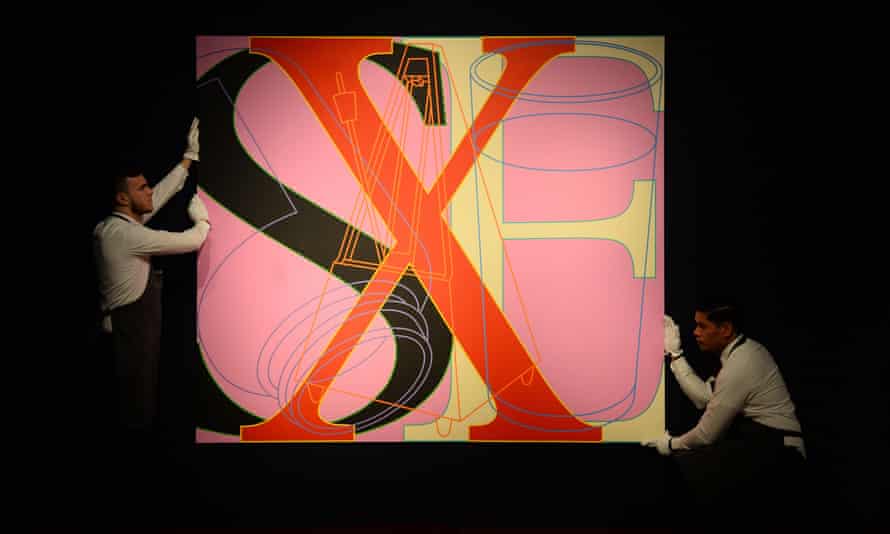
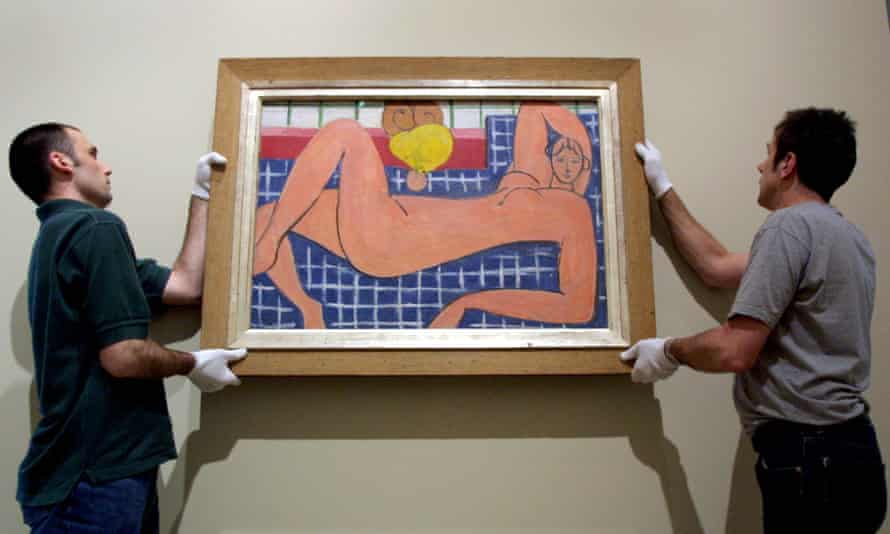
O nce a crate has reached its destination, the handlers take over. At large museums this will be an in-house squad, but many shipping companies now utilise their own handlers, who wait afterwards every phase of the process, for art fairs and individual clients too as galleries. The job might require lifting a half-tonne Assyrian stone relief with a mechanical hoist and manoeuvring it downward a narrow corridor. Or it could involve repositioning a small-scale gimmicky painting a few millimetres upward a wall.
Some handlers I interviewed referred to their arts and crafts as an art; many, indeed, are artists, working as handlers to pay the bills. It is an irony of the art world that while the work's dimensions and concrete materials – canvass, marble, plywood, paper, neon – are painstakingly recorded and displayed, the army of people who ensure that no impairment comes to them are about e'er nameless. "You don't practise information technology for the glamour," one handler who works for a major New York museum told me wryly. Like several others I interviewed, he had no wish to exist identified: he'd lose his chore.
One handler who was happy to exist named was Mikei Hall, frequently spoken of with reverence within the tightly knit world of British fine art installation. Now a senior handling technician at Tate, he has worked at the gallery for 30 years.
We met at Tate Britain ane placidity autumn afternoon. As we strolled through swarms of schoolchildren, he confessed that he sometimes institute it hard to look at piece of work in its own terms. "I'll see something, and recollect: 'How have they done that?'"
Experienced handlers volition plot the choreography of people involved in conveying an object from the second information technology leaves the basement stores to the moment information technology reaches the right spot in the gallery. Checking that the work volition actually fit through the doors is an important role of the task: ane conservator I spoke to remembered a corporate collector who had miscalculated the size of their Rothko, and been forced to have it off its stretchers and roll information technology upwardly to go it into the right room. "Double-handling" (touching things more once, thus increasing the risk) is avoided at all costs.
"Your job is really to make everyone feel comfortable," the New York handler said. "Naught's going to get damaged, the curator'due south relaxed, the creative person is relaxed, people are doing things gracefully and advisedly and precisely."
Similar humans, works of art demand fourth dimension to recover afterwards long journeys, and are usually brought into the galleries 24 hours ahead, to acclimatise before unpacking. As presently as the crate is opened, a "status check" volition happen, to make sure nothing untoward has occurred – ordinarily comparing the work with photos or diagrams that nautical chart pre-existing damages such as delamination of the paint surface, known as "tenting", or "crizzling", glass disease.
Impairment in transit occurs, although naturally no one wants to talk about it. Fine art fairs and auction houses are notorious for slipshod handling – "it's all only product to them," said the conservator – and some commercial galleries aren't much amend. When nosotros spoke, she had recently finished restoring a water-damaged painting that a security guard had left under an open skylight. Forklifts are lethal, she explained: "1 wrong motion and they'll go directly through the example."

The blight of her life was bubblewrap, which leaves indentations fifty-fifty on dry out paint. Recently, a collector too cheap to pay for a proper crate while shipping a painting had fashioned his ain out of cardboard lined with bubblewrap, ruining the piece of work.
Some works, particularly mod ones, aren't all that well made to begin with. Papier-mache from the 1970s is notoriously fragile, and pre-1980s sculptures that contain electrics are infamous for dodgy wiring. Damien Hirst's preserved-fauna sculptures are known to leak gaseous formaldehyde (although not at noxious levels). Hirst'due south "wing" paintings, made by gluing thousands of insect carcasses to sheet, are rumoured to accept a addiction of shedding flies. "Plus, they smell atrocious," another handler I interviewed said. (Hirst'due south gallery, White Cube, said: "It's not common for flies to become dislodged or fall off.")
Nonetheless, Hirst probably holds the record for about-travelled fine art work: an aluminium spot painting of his was installed on the 2003 Beagle 2 probe destined for Mars, where it was used to calibrate scientific instruments. When the probe crashed on the planet'southward surface the following yr, the work was lost, in what might count as the priciest art-handling blow of all fourth dimension.
Many historic museum buildings are not designed to business firm the heavy, large-scale gimmicky works that are now commonplace, significant the walls or floors have to be reinforced, or complicated crane strategies devised to squeeze works in through windows or lift them over roofs. Ai Weiwei's 2015 Regal Academy retrospective involved Momart technicians lugging 90 tonnes of steel rebar in boxes up the ornamental staircase (these artworks, at to the lowest degree, weren't fragile). Getting large sculptures into the Venice Biennale, the primal section of which takes places in the medieval Arsenale complex, is notoriously difficult, requiring specialist cranes with legs that sit in the mud of the lagoon.
In June 1970, a three-and-a-half tonne Alexander Calder sculpture was beingness lowered into place at Princeton Art museum when the base of the crane complanate; two engineers died. The following year, at Minneapolis's Walker Fine art museum, an eight-foot foursquare slab of steel plate, half of Richard Serra's monumental Sculpture No 3, bankrupt loose from its back up and fell on to a rigger, Raymond Johnson, killing him. (The creative person was exonerated, and the fabrication company were found negligent.)
Another handler I spoke to recalled unloading a large Anselm Kiefer painting from a truck. "It was admittedly massive, took 10 guys, and there was a actually sketchy moment when the wind got upwardly. Information technology nearly went over; even in those massive cases, there's a lot of flex. They e'er say, if it starts to motility, get out of the way. Art isn't worth anyone's life. But those things are then expensive, you know? If it gets dropped you'll definitely get sacked."
Ideally, a work volition travel with extensive documentation detailing how it should be assembled, phase by phase, like an elaborate version of Ikea flatpack instructions (normally printed documents, although videos are increasingly common). But – and anyone who's ever assembled an Ikea flatpack tin sympathize – handlers often have to make it up. If the creative person is live and available to consult, cracking. Otherwise, they and the curators have to improvise.
Given the pressures, I asked the New York handler what the satisfactions were. "Yous go to unravel the magic, in a way," he replied. "You lot see the backs of paintings, how things are assembled. You accept a Cézanne or Picasso in your hands, and y'all'll see a little sketch, or how they've reused a bit of canvas." He laughed softly. "It'south intimate, you know?"
Source: https://www.theguardian.com/artanddesign/2019/mar/21/how-to-move-a-masterpiece-secret-business-shipping-priceless-artworks-art-handling
0 Response to "Transporting Art Goods to Be Sold in the Us"
Enregistrer un commentaire